Why 4 Support Wheels Are the Right Choice When Choosing a Grand Max Spring Harrow
When choosing a spring harrow for agriculture in Ukraine and Europe, farmers increasingly pay attention not only to working width, spring tine type, and frame design, but also to the number of support wheels. This parameter directly affects machine stability, working depth, crop safety, and final yield.
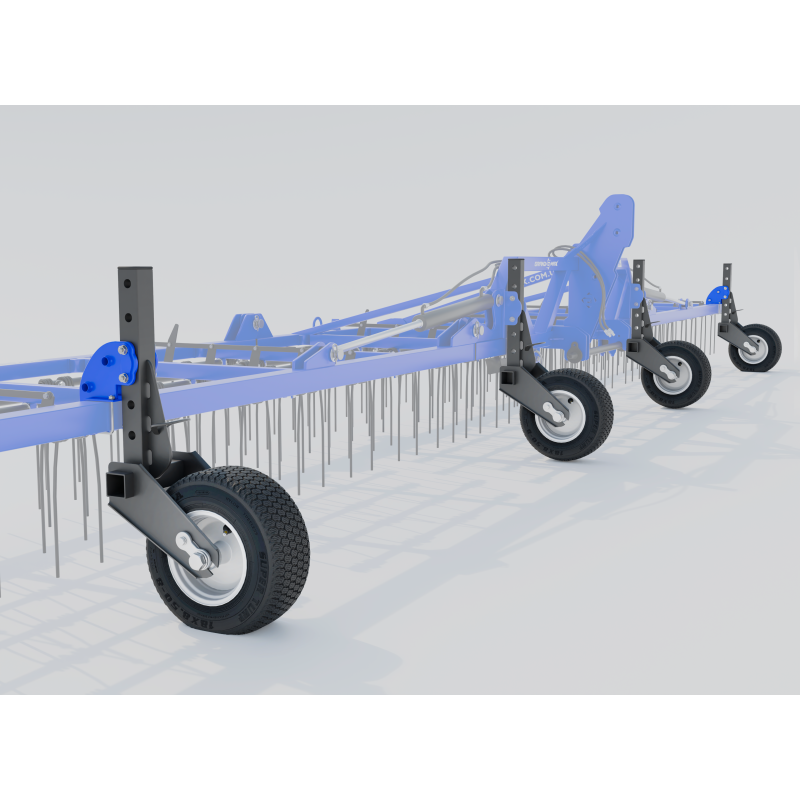
The Grand Max spring harrow is designed to operate with both two and four support wheels, depending on agronomic tasks and field conditions. This is not an unnecessary option, but a well-thought-out engineering solution based on the practical experience of Ukrainian and European farms.
Practice of Using Spring Harrows in Ukraine
In most agricultural enterprises, spring harrows are used in two main operating modes:
-
With Ø7 mm spring tine – for working on seedlings and young crops
(Striegel Harrow – EcoTerra Striegel 3.0 / 6.0 / 9.0)
-
With Ø10 mm spring tine – for moisture retention, early spring harrowing, and field leveling
(Straight Spring – EcoTerra 3.0 / 6.0 / 9.0)
For these working modes, the number of support wheels plays a key role in ensuring high-quality soil cultivation.
Working on Seedlings (Ø7 mm Spring Tine): Why 4 Wheels Are Essential
When harrowing young crops, the main goal is to maintain stable working depth and uniform pressure of spring tines across the entire working width.
Even minor deviations in depth can damage plants and reduce crop yields.
Advantages of Four Support Wheels:
✔ the harrow frame accurately follows field contours
✔ no “diving” of sections on uneven terrain and tractor tracks
✔ stable and predictable pressure on each tine
✔ minimized risk of crop damage
✔ uniform operation across widths of 7–9 m and more
With only two support wheels, long harrows tend to “flex”: the central section works steadily, while side sections may sink too deep or lose soil contact. When working on seedlings, this becomes a critical risk factor.
Therefore, for mechanical weeding, organic farming, and work with young crops, specialists recommend choosing Grand Max spring harrows with four support wheels.
Moisture Retention and Early Spring Cultivation (Ø10 mm Spring Tine): 2 or 4 Wheels?
When working on open soil, stubble, or in early spring, accuracy requirements are lower than for seedling cultivation.
In this mode:
-
working depth is less critical
-
wider operating range is allowed
-
main goal is breaking soil crust and conserving moisture
-
field leveling is important
Available Configurations:
✔ 2 Support Wheels
— simpler design
— lower weight
— optimal price
— sufficient stability for moisture retention
✔ 4 Support Wheels
— maximum depth control
— better uniformity
— high stability on uneven fields
— comfortable operation at large working widths
The Grand Max spring harrow allows you to select the optimal configuration without compromising cultivation quality.
Spring Harrow Without Wheels: Basic Solution for Simple Tasks
Some farms use models without support wheels, especially on small areas.
Suitable if:
✔ fields are flat
✔ working area is limited
✔ low-power tractors are used
✔ basic operations are performed
Advantages:
✔ minimum cost
✔ simple construction
✔ low weight
Limitations:
◯ limited depth control
◯ instability on uneven terrain
◯ not recommended for seedling cultivation
Wheel-less harrows are usually chosen by farmers who want to minimize initial investment.
Comparison Table: Which Configuration to Choose
| Parameter | No Wheels | 2 Wheels | 4 Wheels |
|---|
| Frame Stability | Low | Medium | Maximum |
| Depth Control | Limited | Good | Ideal |
| Work on Seedlings | ✖ | ◯ | ✔ |
| Moisture Retention | ✔ | ✔ | ✔ |
| Work on Stubble | ✔ | ✔ | ◯ |
| For Width 6–9 m | ✖ | ◯ | ✔ |
| Risk of Crop Damage | High | Medium | Minimum |
| Cost | Low | Medium | Above Average |
✔ — recommended
◯ — acceptable
✖ — not recommended
European Approach and Grand Max Experience
Leading European manufacturers of spring harrows (Einböck, Hatzenbichler, APV) use multi-wheel frame systems for seedling cultivation.
The standard for 6–9 m machines includes:
The main European principle is not to increase machine weight, but to ensure structural stability.
This principle is integrated into the design of Grand Max spring harrows, adapted to real field conditions.
Compatibility with the Grand Max Product Line
All Grand Max spring harrow models can be equipped with:
-
no support wheels
-
two wheels
-
four wheels
This makes it possible to select equipment for specific crops, soil types, and cultivation technologies without overpaying for unnecessary options.
Which Option to Choose: Quick Recommendations
Choose a harrow without wheels if:
✔ you work on small fields
✔ you perform simple tasks
✔ you have a limited budget
Choose a 2-wheel harrow if:
✔ you focus on moisture retention
✔ you prepare the seedbed
✔ you need a versatile solution
Choose a 4-wheel harrow if:
✔ you work on seedlings
✔ you practice mechanical weeding
✔ you use wide working widths
✔ you apply organic farming methods
✔ you need high precision
Why Farmers Choose Grand Max Spring Harrows
Grand Max spring harrows are developed considering:
✔ Ukrainian climate conditions
✔ soil structure
✔ intensive farming technologies
✔ European quality standards
Key Advantages:
Conclusion
Choosing the right number of support wheels is an investment in stability, productivity, and profitability.
✔ 4 support wheels – maximum precision, stability, and crop protection
✔ 2 wheels – efficient solution for moisture conservation
✔ No wheels – cost-effective option for basic tasks
Grand Max spring harrows are not a compromise, but a flexible solution tailored to the specific needs of your farm.