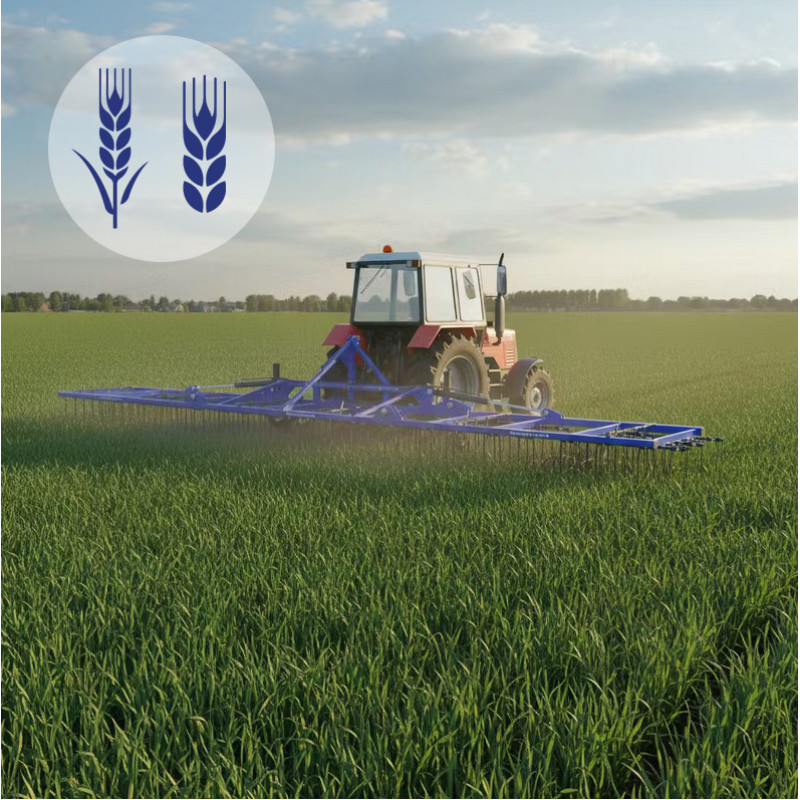
How to Properly Use a Spring Harrow on Wheat: Selection and Technology
How to Properly Use a Spring Harrow on Wheat: Spring Selection, Timing, and Cultivation Technology
A spring harrow for wheat is one of the most effective tools for mechanical crop care, weed control, breaking soil crust, and improving soil aeration. Properly selected equipment and compliance with agronomic practices help increase yields, reduce herbicide costs, and improve plant development.
In this article, we will discuss when and how to use a spring harrow on wheat, which spring to choose — 400 mm, 500 mm, or Striegel — and under which conditions maximum efficiency can be achieved.
Why Use a Spring Harrow on Wheat Crops
A modern spring harrow for wheat performs several important functions at once:
-
elimination of thread-like and young weeds;
-
breaking the soil crust;
-
improving air exchange in the root zone;
-
preserving soil moisture;
-
stimulating tillering and root development;
-
reducing herbicide load;
-
leveling the field surface.
Regular harrowing is especially effective in farms that use resource-saving technologies and elements of organic farming.
At Which Growth Stage Can Wheat Be Harrowed
The effectiveness of cultivation directly depends on the crop growth stage.
1. Before Emergence (Blind Harrowing)
Period: 3–6 days after sowing
Purpose: destruction of emerging weeds
Depth: minimal
Risk of damage: none
Blind harrowing allows up to 80% of early weeds to be destroyed before crop emergence.
2. Tillering Stage (2–4 Leaves) — Main Treatment
This is the most favorable period for wheat harrowing:
-
plants are well rooted;
-
the root system is actively developing;
-
high resistance to mechanical impact;
-
maximum weed control effect.
✔ Optimal stage — early and mid-tillering.
3. Stem Elongation Stage (Limited Use)
Allowed only when necessary:
-
minimum spring pressure;
-
reduced speed;
-
careful operation.
If the risk of damage is high, treatment should be avoided.
Suitable Soil Moisture for Wheat Harrowing
For effective spring harrow operation, the soil should be:
✔ moderately dry
✔ loose and friable
✔ free from sticking
Optimal conditions:
-
moisture: 60–75% of full water-holding capacity;
-
slightly dried surface;
-
weeds in the “white thread” stage.
✖ Not recommended:
-
on wet soil;
-
immediately after rain;
-
when soil sticks to the springs.
In wet conditions, efficiency decreases and the risk of plant uprooting increases.
Best Time of Day for Harrowing
The best time to harrow wheat is:
✔ From 10:00 AM to 5:00 PM
During this period:
-
plants are more elastic;
-
stem brittleness decreases;
-
weeds dry faster;
-
crop losses are minimized.
✖ Not recommended:
-
early morning (dew);
-
evening;
-
cloudy weather with high humidity.
Which Spring to Choose for Wheat Cultivation
The choice of spring affects working depth, treatment intensity, and crop safety.
1. Straight 400 mm Spring — Universal Option
✔ Best solution for most farms
Suitable for:
-
early spring cultivation;
-
medium and light soils;
-
standard conditions.
Advantages:
✔ balanced pressure
✔ effective weed control
✔ minimal stress for wheat
✔ stable working depth
Recommended Grand Max model:
✔ Straight spring — EcoTerra 3.0 / 6.0 / 9.0 (400 mm)
2. Straight 500 mm Spring — For Difficult Conditions
✔ For compacted and heavy soils
Suitable for:
-
heavy soils;
-
high weed infestation;
-
late cultivation.
Advantages:
✔ increased flexibility
✔ better ground contour following
✔ gentler operation
✔ stability on uneven fields
Recommended Grand Max model:
✔ Straight spring — EcoTerra 3.0 / 6.0 / 9.0 (500 mm)
3. Striegel Spring — For Delicate Cultivation
✔ Best option for early stages and organic farming
Suitable for:
-
young seedlings;
-
shallow weeding;
-
light soils;
-
organic farms.
Advantages:
✔ minimal crop damage
✔ high working precision
✔ gentle impact
✔ effective in the “white thread” stage
Recommended Grand Max model:
✔ Striegel spring — EcoTerra Striegel 3.0 / 6.0 / 9.0
Comparison of Springs for Wheat Cultivation
| Parameter | 400 mm | 500 mm | Striegel |
|---|---|---|---|
| Versatility | ✔✔✔ | ✔✔ | ✔✔ |
| Aggressiveness | Medium | Low | Minimal |
| Damage Risk | Low | Minimal | Very Low |
| Weed Control | ✔✔✔ | ✔✔✔ | ✔✔ |
| For Organic Use | ◯ | ◯ | ✔✔✔ |
Main Harrow Settings for Wheat Cultivation
For maximum efficiency, it is recommended to set:
✔ moderate spring pressure
✔ working depth — 2–3 cm
✔ speed — 8–12 km/h
✔ uniform operation across working width
✔ depth control along the entire frame
A test pass is recommended before main operation.
Common Mistakes in Wheat Harrowing
✖ Working on wet soil
✖ Excessive speed
✖ Excessive spring pressure
✖ Late cultivation
✖ Lack of adjustment
Such mistakes may result in the loss of up to 10–15% of plants.
Why Choose Grand Max EcoTerra Series Harrows
Grand Max EcoTerra spring harrows are designed in accordance with modern agronomic standards and cereal crop requirements.
Equipment advantages:
✔ reinforced frame construction
✔ precise adjustment system
✔ wear-resistant springs
✔ adaptation to climatic conditions
✔ high reliability
✔ manufacturer technical support
Available models:
-
EcoTerra 3.0 / 6.0 / 9.0 (400 mm and 500 mm)
-
EcoTerra Striegel 3.0 / 6.0 / 9.0
Conclusion: Which Spring Harrow to Choose for Wheat
✔ For most farms — straight 400 mm spring
✔ For difficult conditions — straight 500 mm spring
✔ For early stages and organic farming — Striegel spring
Best working conditions:
-
tillering stage (2–4 leaves);
-
dry and loose soil;
-
daytime operation;
-
moderate speed.
A properly selected spring harrow for wheat is an investment in clean fields, healthy plants, and stable yields.
If you need assistance in selecting Grand Max equipment for your farm conditions, contact the plant’s specialists. We will help you find the optimal solution for efficient operation.